Fertilizer Market Update: Urea, MOP and Sulfur in a Hormuz-Disrupted World
It has been ten weeks since the closure of the Strait of Hormuz on 28 February turned the global fertilizer trade on its head. As planting windows tighten across the Northern Hemisphere, the market this week is showing the first tentative signs of physical flow returning. But the pricing damage is done. Structural tightness remains, and buying activity out of India is setting the tone for the rest of the year.
Here is our read on where urea, MOP and sulfur stand this week, plus what we are watching from the trading desk.
The Backdrop: Hormuz, Briefly
About one-third of seaborne fertilizer trade moves through the Strait of Hormuz. That works out to roughly 16 million tonnes a year of nitrogen, phosphate and sulfur products. After the conflict began, daily transits collapsed by more than 95 percent, falling from over 100 vessels per day in late February to single digits within weeks, according to UN Trade and Development.
The Persian Gulf accounts for roughly 30 to 35 percent of global urea exports and about a quarter of global sulfur supply. So the trade impact has fallen disproportionately on those two products.

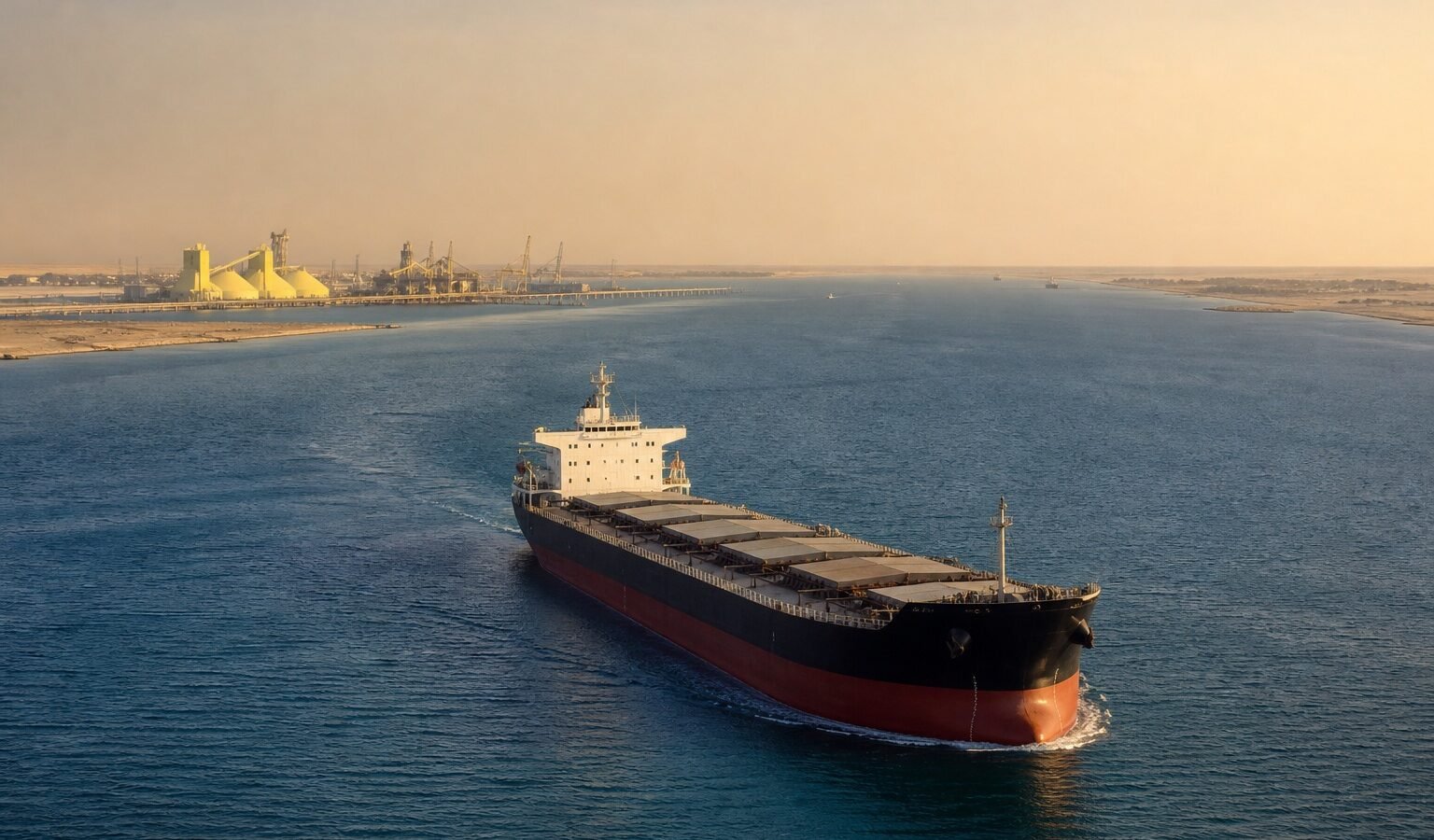
Cargoes that loaded at UAE ports in late March are only now finding safe passage. The Richsing Lotus, carrying around 50,000 tonnes of granular sulfur from Ruwais to Morocco’s Jorf Lasfar, finally cleared the strait between 1 and 6 May after waiting at anchor since 27 March, according to Argus Media. It is one of the latest in a slow trickle of vessels resuming movement. The backlog is enormous, and freight and war-risk insurance costs have repriced the entire delivered cost stack.
Urea: The Sharpest Move
Of the three major nutrient groups, nitrogen has taken the heaviest hit. The reason is structural. Nitrogen is the one input you cannot defer. Potash and phosphate applications can be skipped or reduced for a season. Nitrogen application has to happen every cycle, or yield is lost.
Granular urea FOB Egypt, the bellwether benchmark, has traded as high as USD 700 per tonne in recent weeks against a pre-war range of USD 400 to 490. Egyptian domestic prices spiked nearly 28 percent within days of the conflict starting, per FAO data. CBOT urea futures closed at USD 616.25 per tonne on 6 May, with the FOB US Gulf granular contract at USD 628. Prices have come off the March panic highs, though they remain roughly 25 percent above year-ago levels.

The supply side remains constrained:
- Qatar’s QAFCO complex, which alone supplies around 14 percent of global urea trade, was forced to halt downstream urea production after QatarEnergy paused LNG output, as reported by CNBC. Restart timing remains uncertain.
- China’s export restrictions are extended through end-August 2026, per American Farm Bureau. That removes one of the few alternative supply sources from the global pool.
- Egypt’s gas pressure is squeezing North African production economics. Imports from Israel are curtailed and LNG procurement is getting more expensive by the week, according to the Carnegie Endowment.
- EU CBAM, in force since 1 January, is adding a layer of carbon-related cost to imports landed in Europe. The political debate over flexibility mechanisms under exceptional market conditions is now active in Brussels.
Indian buying continues to set the marginal benchmark. With approximately 70 percent of US growers reporting they cannot afford sufficient fertilizer for the current planting season, and with affordability gaps widening across South Asia and Africa, the question for nitrogen producers is no longer whether prices can hold. It is who can actually pay them.
MOP: The Calm in the Storm
Potash has been the relative bright spot in this dislocation, for one simple reason. The bulk of the trade does not transit Hormuz. Canada and the CIS dominate the export pool, and the US sources roughly 90 percent of its potash imports from Canadian production. That structural insulation has spared MOP the most violent of the recent moves.
That said, MOP has not been immune. World Bank tracked spot prices climbed from USD 358 per tonne in January to USD 488 per tonne in March, the highest level since early 2023. Buyers across Brazil, India and Southeast Asia accelerated procurement to lock in volumes before the broader fertilizer panic spread. The Brazilian benchmark closed Q2 2025 at around USD 363 CFR Santos, and Q1 2026 has seen further upside as freight rates climbed and producers held discipline.

Several developments are shaping the outlook from here:
- Belarusian MOP. The US Treasury issued a general licence on 15 December clarifying the 13 December decision to lift sanctions on Belarusian potash. Assuming BPC can re-establish payment channels, Belarusian tonnes should begin re-entering the seaborne market in the next three to four months. EU sanctions remain in place and the Klaipeda route remains closed.
- BHP Jansen in Saskatchewan has slipped again. Stage 1 capex now sits at USD 7.0 to 7.4 billion and first production has been pushed to mid-2027, with Stage 2 potentially delayed by two years. Supply additions from this project will not relieve the market in 2026.
- Indian and Indonesian tenders. A major Indonesian buyer tendered for 155,000 tonnes of standard MOP for June to September delivery (closed 27 April). Indian fertilizer producer RCF’s tender for phosphate rock, DAP/MAP and 50,000 tonnes of crystalline white/pink MOP closes today, 9 May.
Brazilian MOP demand for 2026 is expected to come in at or slightly above 2025’s 13.5 million tonnes. Stocks entering this year were already on the low side, and the affordability picture for potash relative to nitrogen is firmly supportive. That is a structural bullish factor for the second half.
Sulfur: Tight Before the Crisis, Tighter Now
Sulfur entered 2026 already structurally tight. The market peaked in January and was already pricing in constrained refinery output. Sulfur is recovered as a byproduct of oil and gas processing, so when refining margins compress, sulfur availability tightens. The Hormuz disruption layered an export flow problem on top of a production problem.
The numbers tell the story. The Q1 Tampa contract printed around USD 310 per long tonne delivered. Market participants are now projecting Q2 settlements in the USD 475 to 520 range, a year-on-year increase of nearly USD 194 per long tonne. Regional spot benchmarks in April 2026 ran approximately USD 690 per tonne in Northeast Asia, USD 600 in India, USD 400 in Europe, USD 330 in the Middle East, and USD 220 in North America. The Asian premium reflects the dependence on Gulf-origin material that simply could not move.

Two things to watch in the immediate term:
- India’s policy response. The Gujarat Chamber of Commerce and Industry has formally asked the chemicals and fertilizers ministry to impose a minimum six-month ban on elemental sulphur exports. With India now buying defensively to backfill domestic phosphate production, an export ban is a real possibility. It would tighten the regional balance further.
- Downstream pressure on amsul, sulfuric acid and DAP/MAP. Higher sulfur feedstock costs are flowing directly into ammonium sulfate, where Q1 2026 offers were already pricing in elevated input costs. They are also flowing into sulfuric acid markets, where copper extractors and phosphate producers are competing for the same constrained molecules.
For our part at Twenty Arms, the FOB Aktau granular sulfur route out of Kazakhstan has become noticeably more interesting to buyers looking outside Strait of Hormuz exposure. CIS-origin material that can move via Black Sea or rail-to-port routes is, for now, a hedge against the Gulf risk premium.
What We’re Watching
A few signals matter more than the headline price prints right now:
- Vessel transits through Hormuz. Each cargo that clears, like the Richsing Lotus this week, is a data point on whether physical flow is resuming. The pace will determine whether Q3 sees genuine relief or just sustained tightness.
- Indian tender outcomes. IPL’s 2.325 million tonne DAP and 410,000 tonne TSP tender closed 7 May with a low offer of USD 935 CFR east coast and USD 930 CFR west coast. RCF’s MOP and phosphate tender closes today. These tenders are the clearest read on what major buyers are willing to pay.
- China’s August export window. If Beijing lifts or eases restrictions in September, it will provide some pressure relief on phosphates and urea. If the restrictions extend, the market remains tight into Q4.
- Belarusian MOP re-entry. The pace at which BPC re-establishes payment infrastructure will determine when potash sees fresh tonnes.
Bottom Line
The fertilizer market is repricing. This is not just an adjustment for a temporary disruption. The supply chain is reshuffling around a region that is no longer reliable counterparty risk. Buyers who locked in second-half coverage in February are looking smart. Buyers still uncovered are negotiating in a market where the seller has more leverage than at any point since 2022.
For traders and intermediaries, the opportunity set is unusually rich. Arbitrage between Gulf-exposed and Gulf-insulated origins. Structured payment terms in a credit-tight environment. Inspection-led settlement as a way to bridge buyer-seller trust gaps. We are seeing more of all three across our deal book this quarter.
We expect volatility to persist through the second half. Anyone in the value chain, whether producer, trader, or end-user, should be planning around tightness, not loosening, as the base case for the rest of 2026.
Sources
- UN Trade and Development (UNCTAD) on fertilizer disruptions and food security risk
- FAO / Global Agriculture on the Strait of Hormuz conflict and global fertilizer supply
- CNBC on the Strait of Hormuz blockage and commodity price impacts
- Carnegie Endowment for International Peace on the fertilizer crisis
- World Fertilizer / ICIS on food security and surging fertilizer costs (7 May 2026)
- Argus Media fertilizer market news, including the Richsing Lotus sulphur cargo and IPL tender results
- Argus Media on potash demand outlook for 2026 (Fertistream interview)
- Argus Media on sulfur costs supporting ammonium sulfate prices in 2026
- IMARC Group sulphur price trend report (April 2026)
- PriceWatch on the muriate of potash (MOP) price trend
- Investing News Network agriculture market Q1 2026 review
- ICIS on potash analytics and the BHP Jansen capex update
- farmdoc daily / University of Illinois on Strait of Hormuz closure and fertilizer supply risks
- American Farm Bureau Federation on Middle East tensions and the spring planting season
- Trading Economics urea spot price data
Twenty Arms Inc. is an independent commodity trading company headquartered in Canada. For inquiries, contact the trading desk at trading@twentyarms.com. Nothing in this commentary constitutes investment advice. Readers should conduct their own due diligence before entering any transaction.